
Frozen Shoulder Healing
Diagnostic Methods and Treatment Options

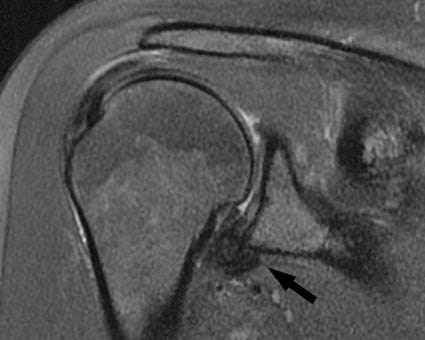
MRI of adhesive capsulitis with arrow to dark fibrosis of shoulder capsule
The PDF Frozen Shoulder Healing: Diagnostic Methods and Treatment Options eBook with 200 hyperlinked references covering 29 different anti-inflammatory remedies, injection procedures, manual therapies, and surgical approaches is available for download from the Let Magic Happen store. It is also available as a Kindle eBook, Audiobook and Paperback on Amazon. The paragraphs below are excerpted from the book, and the contents are summarized in this 2-minute video.
If you found your way to this book, you probably have had symptoms for many days or weeks already, as the unexplained onset of pain with frozen shoulder (FS) can be quite baffling for a while until you eventually find out about this mysterious affliction. There are many other possible causes of shoulder pain, but when you start to lose your range of motion (ROM) it inevitably leads you down the adhesive capsulitis rabbit hole on a quest for answers.
The diagnosis of FS is usually made clinically based on the typical history of unexplained onset of shoulder pain followed by gradual loss of ROM in the 1st and 2nd freezing stages of inflammation. Dramatic decreases in forward flexion, abduction, and external and internal rotation occur in the 3rd frozen stage as the synovitis is replaced with fibrosis and constant pain begins to diminish. The inability to move the hand above shoulder level leads to inevitable comparisons to the short arms of the dreaded prehistoric predator T. Rex in this video.
If an experienced clinician suspects another diagnosis inexpensive plain radiographs will be the first step which are usually normal in FS. When an MRI or ultrasound that was ordered to exclude a possible rotator cuff abnormality does not show a tear, thickening of the capsule in the axillary recess and around the coracohumeral ligament at the rotator cuff interval can confirm the diagnosis of FS. However, in idiopathic primary FS neither one of these expensive imaging tests is routinely necessary if the history and physical examination are diagnostic.
Most patients with FS are between 40 and 60 years of age with 70% being women. Menopause and diabetes are the biggest risk factors due to loss of the anti-inflammatory effect of estrogen and the pro-inflammatory effect of elevated blood sugar. It occurs in up to 5% of the general population and in up to 10% with type 1 diabetes and in up to 22% with type 2 diabetes. FS is also associated with HLA-B27 positivity and autoimmune disease including hyperthyroidism from Grave’s disease and hypothyroidism from Hashimoto’s disease.
The many options are listed here in the order of suggested implementation from non-invasive and inexpensive approaches to invasive and expensive procedures. I will not discuss muscle relaxants and analgesic approaches that do not decrease inflammation such as pain relief creams. In accordance with the 4 stages of FS, it is best to begin with anti-inflammatory choices in the freezing stage prior to using therapies that focus on mobilization of the joint to regain ROM that may cause more inflammation if started too early. Manipulation under anesthesia, arthroscopy, and embolization which have significant risks should be reserved as a last resort.
I hope the many therapeutic options above will assist you in healing your FS. To prevent getting a 2nd one, it would be wise to release any residual emotional issues that may have triggered your 1st one using the FS EFT video. If you need a bigger breakthrough than is possible in an online group tapping session, I offer individual Zoom coaching sessions. I have openings for free consults most days of the week at 11 AM ET, plus some scattered times in the afternoons. The Zoom coaching sessions are 80 minutes between 2 and 7 PM ET most days of the week.
My shoulder was frozen and painful for a couple of years. Very painful actually, but by the time my Workmen’s Comp surgery was coming due I was halfway through the normal amount of time for it to heal without intervention , so I bore it naturally for the remaining year and am glad I did. My shoulder is 100% healed now whereas after surgery it never would’ve healed 100%. It would have been stiff for the rest of my days in this bizarre world.
Anything for trouble healing SI joint injury?